In today’s digital world, tech impacts the business in ways that can’t be ignored if you are looking to be efficient, run your operations accurately, and delight your customers. Information management can be complex as an organization expands and requirements increase, regarding sales, finances, inventories, employees, and customers’ information. That’s why there are enterprise software solutions like Customer Relationship Management (CRM) systems and Enterprise Resource Planning (ERP) systems that many companies resort to these days.
Though both CRM and ERP systems, they are different yet are meant to propel business effectiveness. While both platforms have their peculiar strengths, knowing the difference between the two can help organizations select the technology that would benefit them the most for their future goals and their business.
What Is CRM?
Customer Relationship Management (CRM) are the programs used to facilitate the management of a business’s interactions and relationships with its customers. It connects key customer data in a single system so sales, marketing and customer service teams are more effective.
Businesses can use a CRM system to keep track of possible customers, handle sales prospects, keep documentation of customer interactions, and monitor deals. Employees now have the ability to get relevant information about customers at one place: not using multiple spreadsheets, emails or disconnected records.
This makes CRM software particularly useful for companies that run with the goal of enhancing sales and customer retention. It could be the tool that sales teams use to follow up on leads, get to know the needs of the customer, and control the sales cycle. Customer data can be utilized by marketing teams for more targeted campaigns, and by customer service teams to provide more personalized support by tapping into past interactions.
Advanced CRM systems are increasingly utilizing artificial intelligence and automation. These technologies have the potential to transform and boost business performance in various ways, such as automating repetitive work, understanding customer behaviour, forecasting sales opportunities and providing more customized experiences.
What Is ERP?
An ERP or Enterprise Resource Planning system is a software solution that is used to organize and link a firm’s business process. As opposed to CRM, ERP systems are more about the organization, and not just the customers.
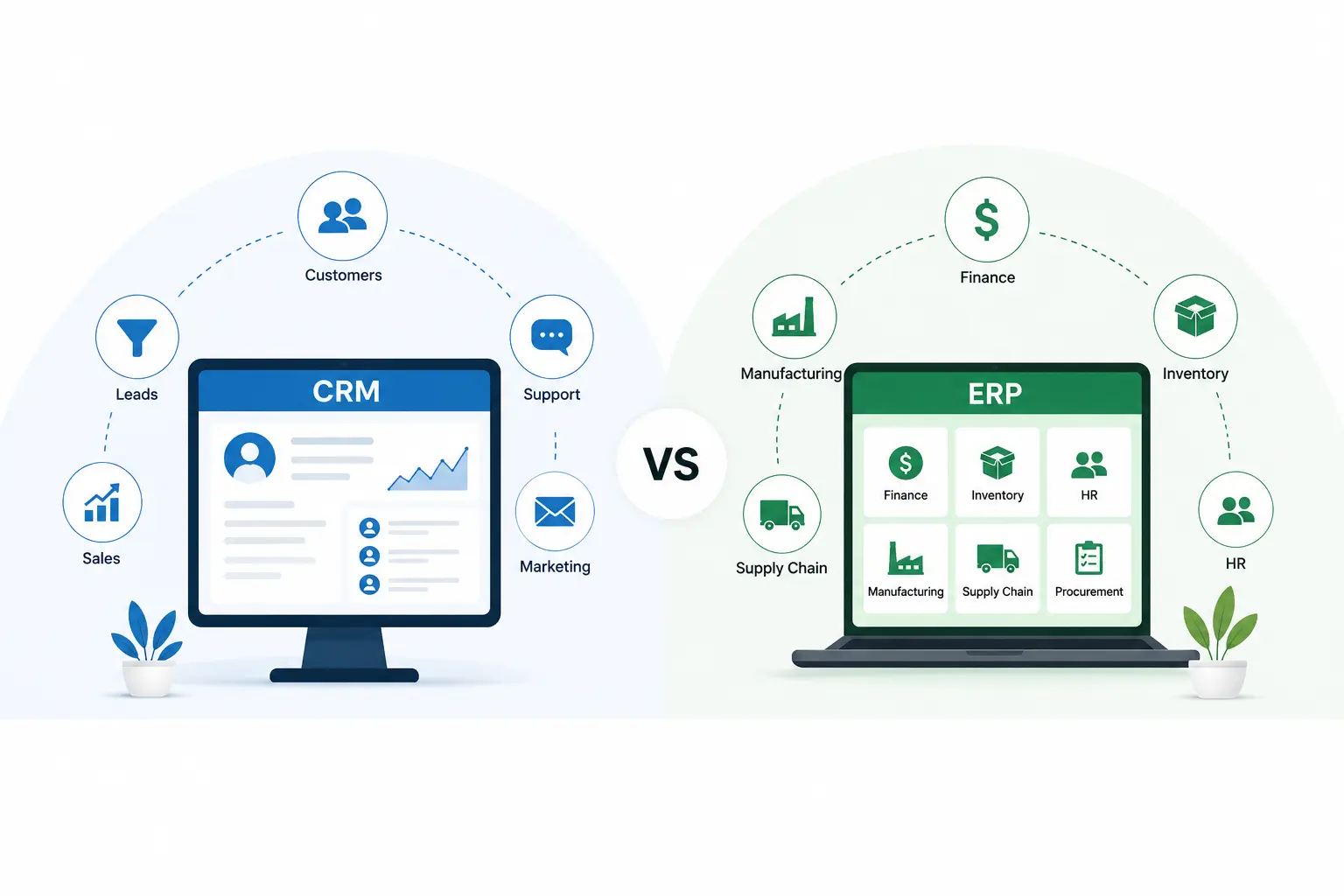
You could be dealing with a system that integrates finance, accounting, inventory, procurement, manufacturing, supply chain and human resources. These functions can bring together to create a more centralized and coordinated functioning environment for businesses.
When a product is sold, for instance, an ERP system can be used to update inventory, record the financial transaction, produce an invoice and possibly plan the delivery. This minimizes the amount of data being duplicated entered by workers.
Medium-sized and large businesses with diverse departments and intricate workflows can prove to be a perfect fit for ERP. ERP systems can help reduce this spread of information, and offer decision making that is faster and more efficient, due to the point in time access to shared information.
Key Differences Between CRM and ERP
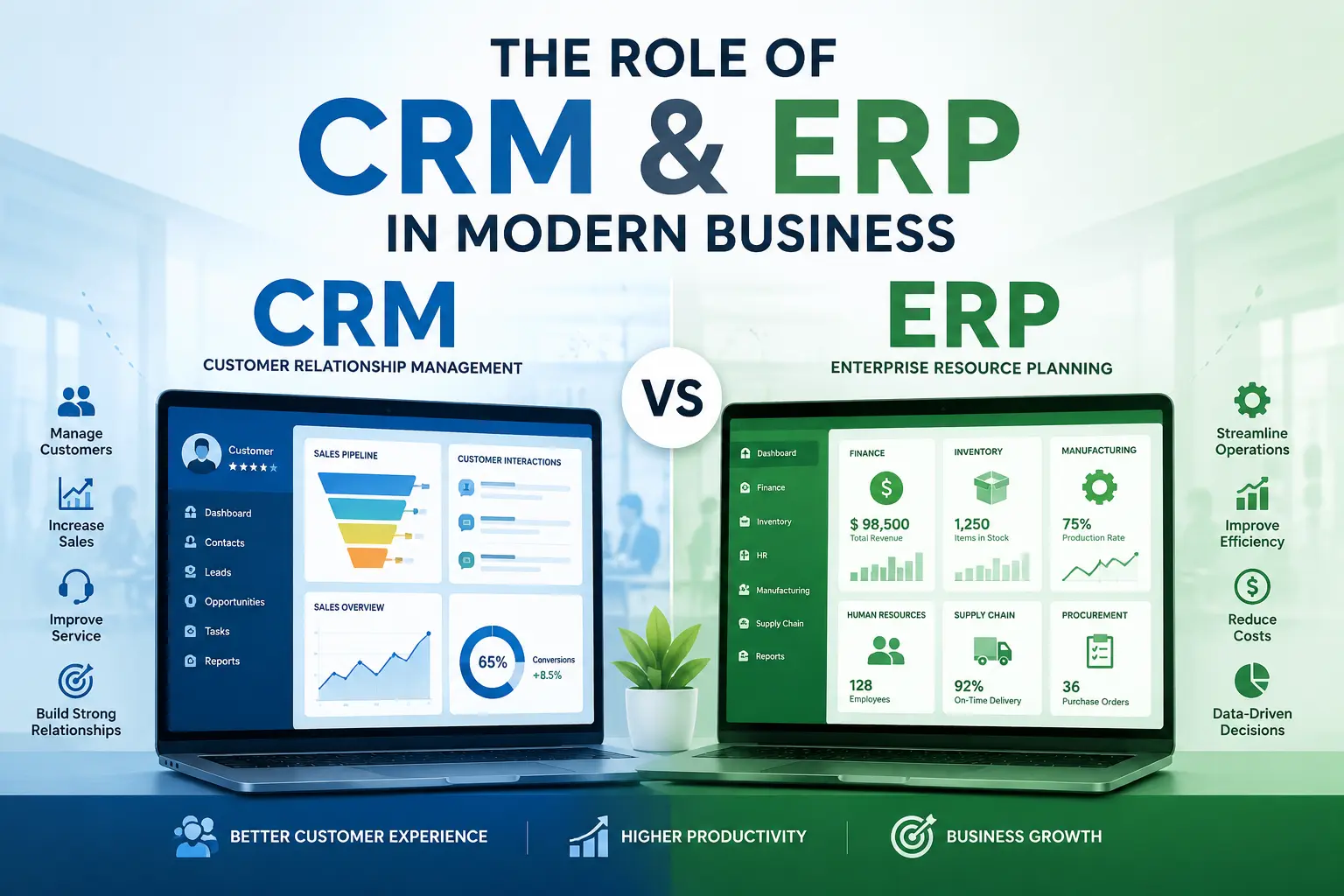
The key difference between CRM and ERP is that it’s a difference in the focus. The main focus of CRM is the customer, sales, marketing and service. The primary goal is to draw in new customers, boost sales and foster better customer relationships.
On the other hand, ERP’s emphasis will be placed on internal business activities. It enables companies to control their resources, costs, departments and enhance their processes. CRM helps businesses increase their revenue, whereas ERP helps an organization to manage the running of its resources and operations more effectively.
These systems can also have various users. The primary user of the CRM software is usually the sales, marketing and customer service departments. The ERP systems are mostly utilized by human resources, finance, management, procurement and operations teams and the supply chain.
Is it Possible for CRM and ERP to Work Together?
Indeed, CRM and ERP systems can collaborate to foster a more integrated business setting. Integration lets different parts share vital information so that customer-facing operations and internal activities can benefit.
The details, for instance, can be synced from the CRM system to the ERP platform, when a sale is completed by a salesperson. The ERP system will then be able to update stock, prepare for an invoice, log the payment and arrange delivery. This linkage helps lower manual data entry hassles, guarantees exactitude and enables various departments access to more precise know-how.
Conclusion
Although different, both CRM and ERP systems have the potential of being beneficial in business growth. CRM is all about enhancing customer relationships and earning more, while the ERP is more about internal motions and efficiency.
That really depends on what it is that a business is trying to accomplish and what the challenges are. There are organizations that can benefit from implementing a CRM first and for others, they need to implement an ERP system to enhance internal processes. When businesses are expanding and incorporating digital technologies, one can get a better understanding of customers, operations and the overall performance of the business by integrating these systems.